Nb-Ti filamant onion blossom superimposed on the Frank Shaw Building, the new home of the Applied Superconductivity Center

NHMFL > ASC > PJL > Master Jc Plots and Nb3Sn Scaling Spreadsheet

The new official "Plots" page can now be found somewhere on the NHMFL web site. The location of the ASC page is not static so try finding the ASC web pages via the main NHMFL entrance at: http://www.magnet.fsu.edu or if you are lucky: http://www.magnet.fsu.edu/magnettechnology/research/asc/plots.html

Below is an enhanced version of the page that may be of use if you have difficulty finding the official version.

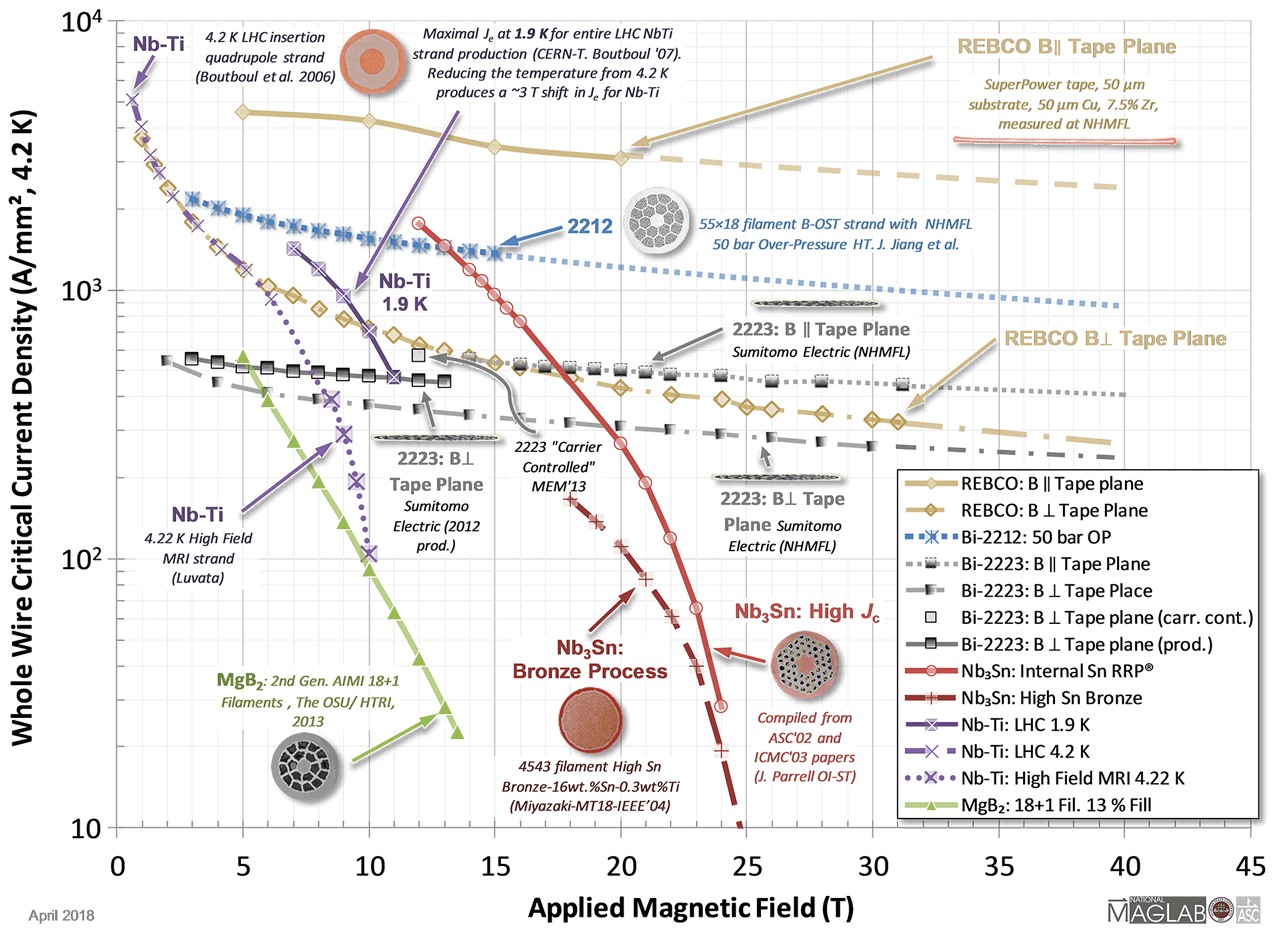
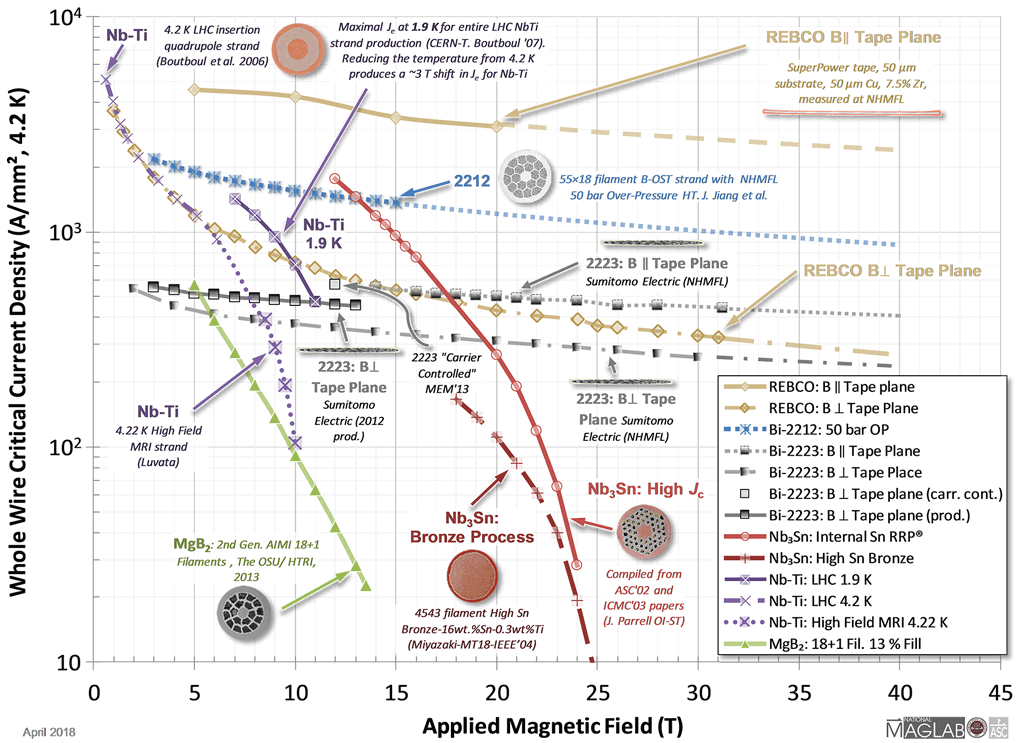
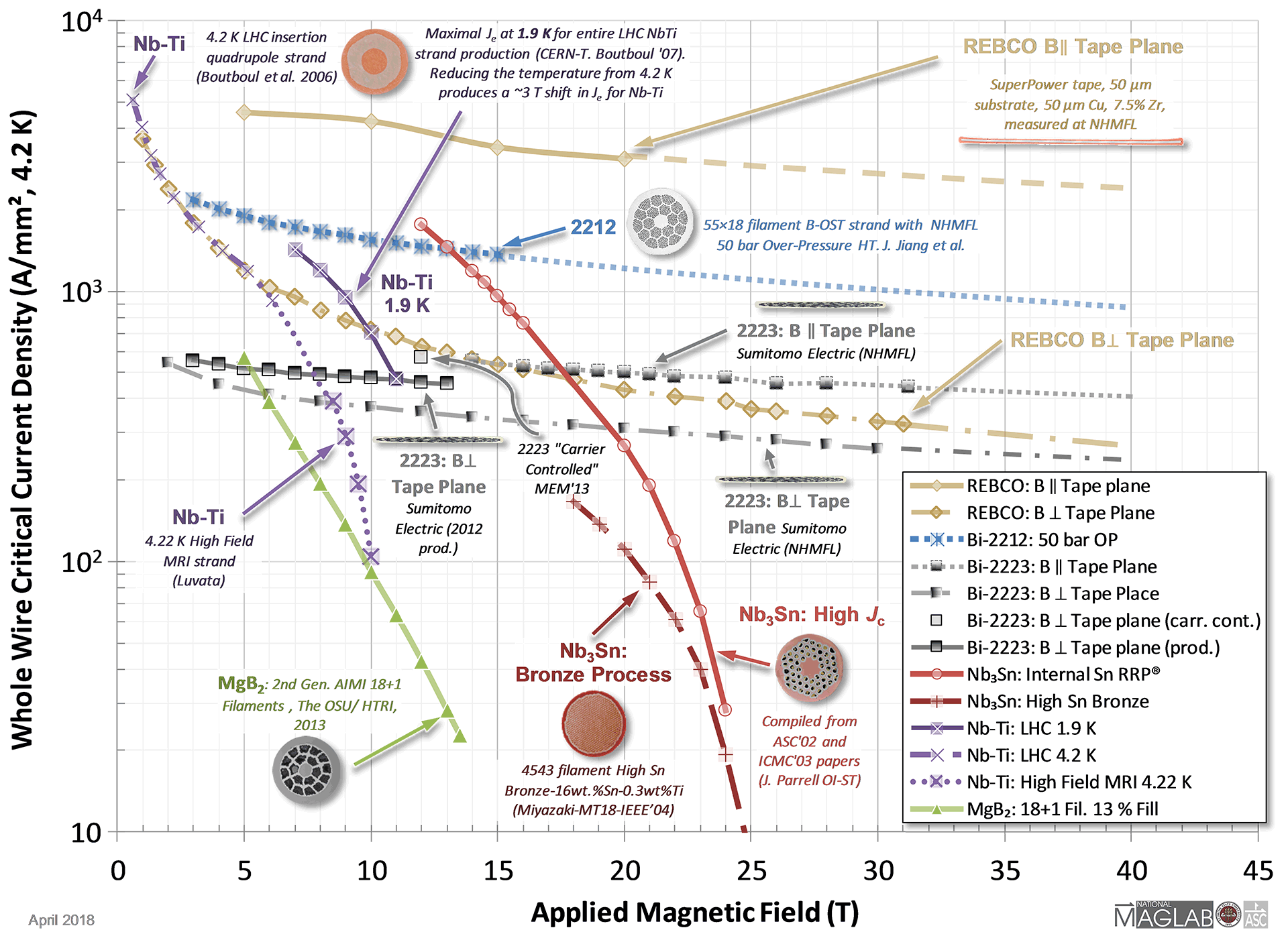
A comparison of Superconductor Critical Currents
Superconductor Engineering Critical Currents - color version

Engineering Critical Current Density vs. Applied Field - March 5th 2010 (typo corrected 7/1/11)

Includes more extensive annotations than previous versions as well as cross-sections of the composites.
946x685 71 kB PNG
1417x1023 126 kB PNG
232 kB Powerpoint File + References
226 kB Excel Worksheet + References


946x685 71 kB Transparent PNG
1417x1023 126 kB Transparent PNG

References:
YBCO: Tape,
Tape-plane, SuperPower "Turbo" Double layer (tested NHMFL 2009). Source: Aixia Xu and Jan Jaroszynski, June 2009. 20 T depression due to He bubble, dashed line estimates true performance.
YBCO: Tape,
Tape-plane, SuperPower "Turbo" Double layer (tested NHMFL 2009). Source: Aixia Xu and Jan Jaroszynski, June 2009
Bi2223 B
Tape-plane "DI" BSCCO Sumitomo Electric Industries (Kitaguchi et al. NIMS) 4 K. See also "Progress in high performance DI-BSCCO wire," M. Kikuchi, N. Ayai, J. Fujikami, S. Kobayashi, K. Yamazaki, S. Yamade, T. Ishida, T. Kato, K. Hayashi, K. Sato, R. Hata, J. Iihara, K. Yamaguchi, H. Kumakura, H. Kitaguchi, K. Osamura, and J. Shimoyama, AIP Conf. Proc. 986, 407 (2008), DOI:10.1063/1.2900375
Bi2223 B
Tape-plane "DI" BSCCO Sumitomo Electric Industries (Kitaguchi et al. NIMS) 4 K. See also Kikuchi et al. Adv. Cryo. Eng., 54, pp. 407-415 (2008) - full reference above.
Bi-2212: OST 2212 wire 0.8 mm, 28% ceramic, 0 to 10 T data taken at OST, 11.5 to 45 T data taken in NHMFL hybrid
Nb-47Ti: 0-6 T - Boutboul et al. MT-19: Boutboul, T.; Le Naour, S.; Leroy, D.; Oberli, L.; Previtali, V.; , "Critical Current Density in Superconducting Nb-Ti Strands in the 100 mT to 11 T Applied Field Range," Applied Superconductivity, IEEE Transactions on , vol.16, no.2, pp.1184-1187, June 2006
doi: 10.1109/TASC.2006.870777
Nb-47Ti 5-8 T Maximal: Nb-Ti: Max @4.2 K for whole LHC NbTi strand production (CERN-T. Boutboul '07)
Nb3Sn (RRP®): Non-Cu Jc Internal Sn OI-ST RRP® 1.3 mm, Parrell, J.A.; Youzhu Zhang; Field, M.B.; Cisek, P.; Seung Hong; , "High field Nb3Sn conductor development at Oxford Superconducting Technology," Applied Superconductivity, IEEE Transactions on , vol.13, no.2, pp. 3470- 3473, June 2003
doi: 10.1109/TASC.2003.812360 and Nb3Sn Conductor Development for Fusion and Particle Accelerator Applications J. A. Parrell, M. B. Field, Y. Zhang, and S. Hong, AIP Conf. Proc. 711, 369 (2004), DOI:10.1063/1.1774590
Nb3Sn (High Sn Bronze): T. Miyazaki et al. MT18 - fig3, Miyazaki, T.; Kato, H.; Hase, T.; Hamada, M.; Murakami, Y.; Itoh, K.; Kiyoshi, T.; Wada, H.; , "Development of high Sn content bronze processed Nb3Sn superconducting wire for high field magnets," Applied Superconductivity, IEEE Transactions on , vol.14, no.2, pp. 975- 978, June 2004
doi: 10.1109/TASC.2004.830344
MgB2: 19 Fil RW - Hypertech 24% Fill data courtesy MikeTomsic 10/25/07

Links to ASC, MT and ICMC Proceedings can be found on the conferences page.

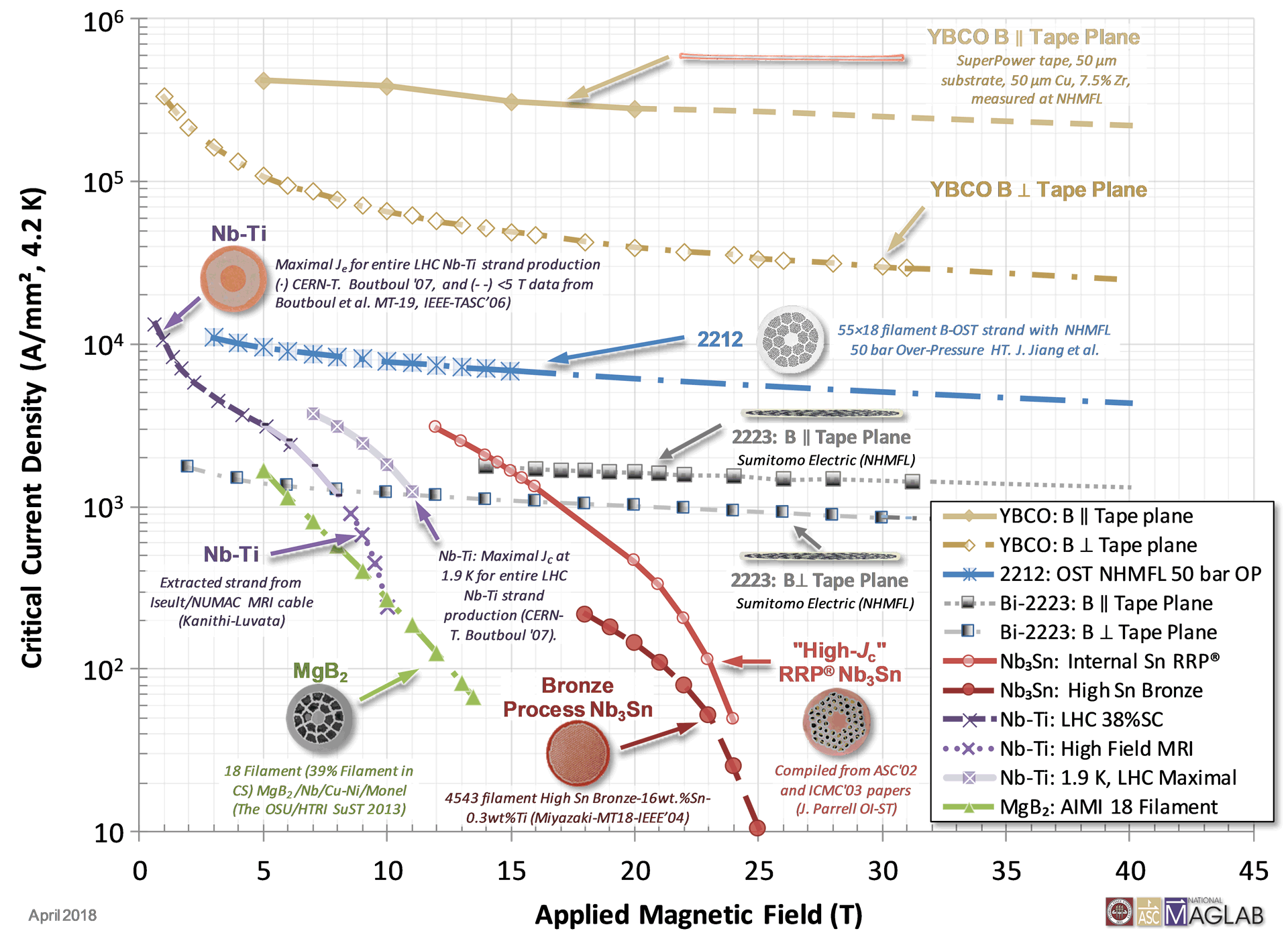
Superconductor Engineering Critical Currents - color version

Simplified (July 1, 2011) Engineering Critical Current Density vs. Applied Field - March 5th 2010

As above but only Nb-Ti, Nb3Sn, 2212 and YBCO
946x685 68 kB PNG
1417x1023 117 kB PNG
182 kB Powerpoint File + References

Color version of <em>J</em><sub>c</sub> plot
Critical Current Density vs. Applied Field: Light Color Version - June 2008
1257x774 130 kB PNG
270 kB Powerpoint File + References
60 kB Excel File + References
Archive of previous versions: http://fs.magnet.fsu.edu/~lee/plot/plotarchive.htm


A Best-of-Breed Comparison of Superconductor Critical Currents for 100 m length capable material

Jc Progress Light Version - December 12, 2002
192 KB PDF
194 KB Powerpoint
48 KB PNG 1156 X 865


Update History
- Opens in a new window


Critical current density values are all normalized to the superconductor cross-section and are in A/mm² (the units most commonly used for magnet applications). The criterion used for determining critical current measurement is not consistent, especially in the case of HTS superconductors.

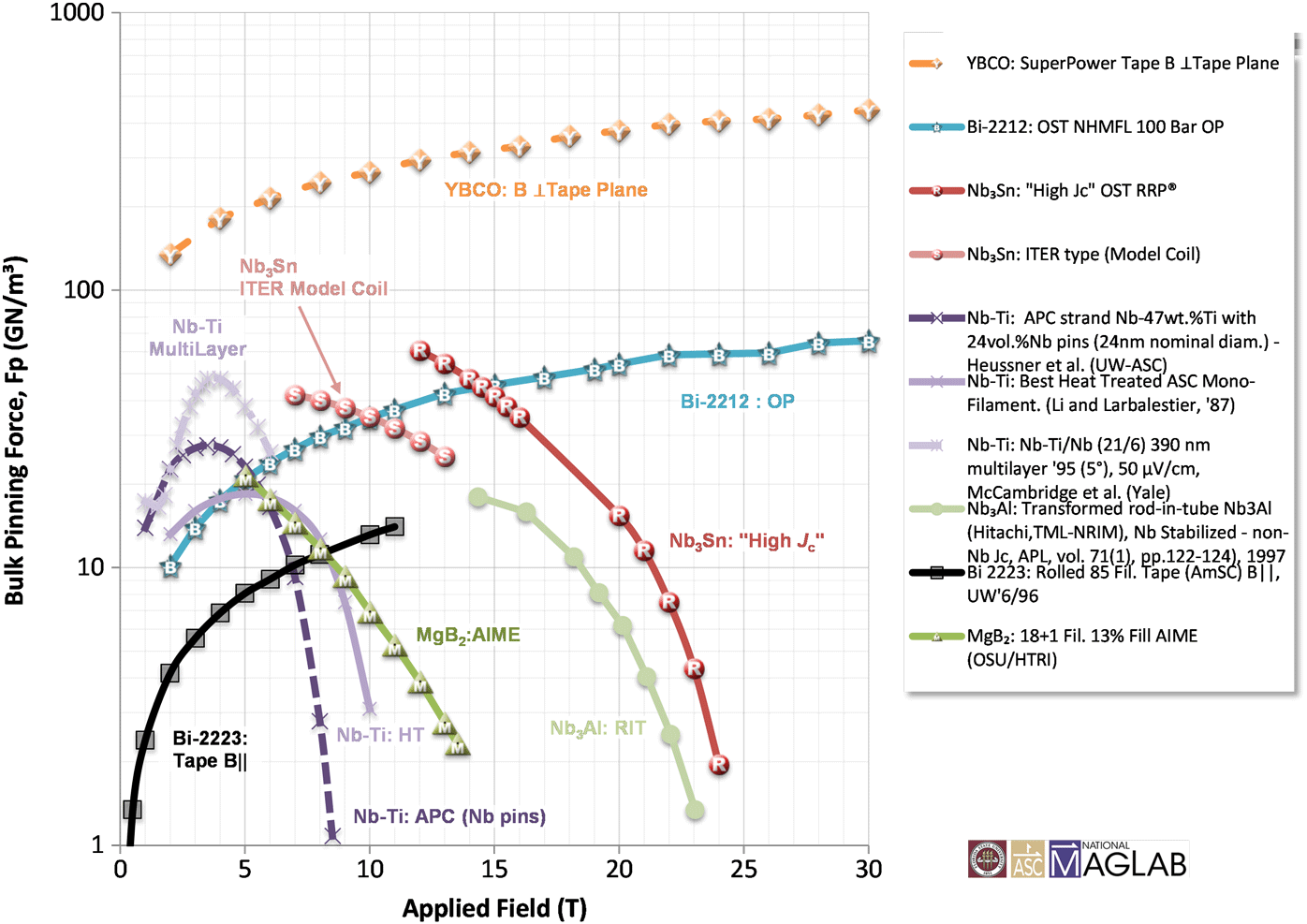
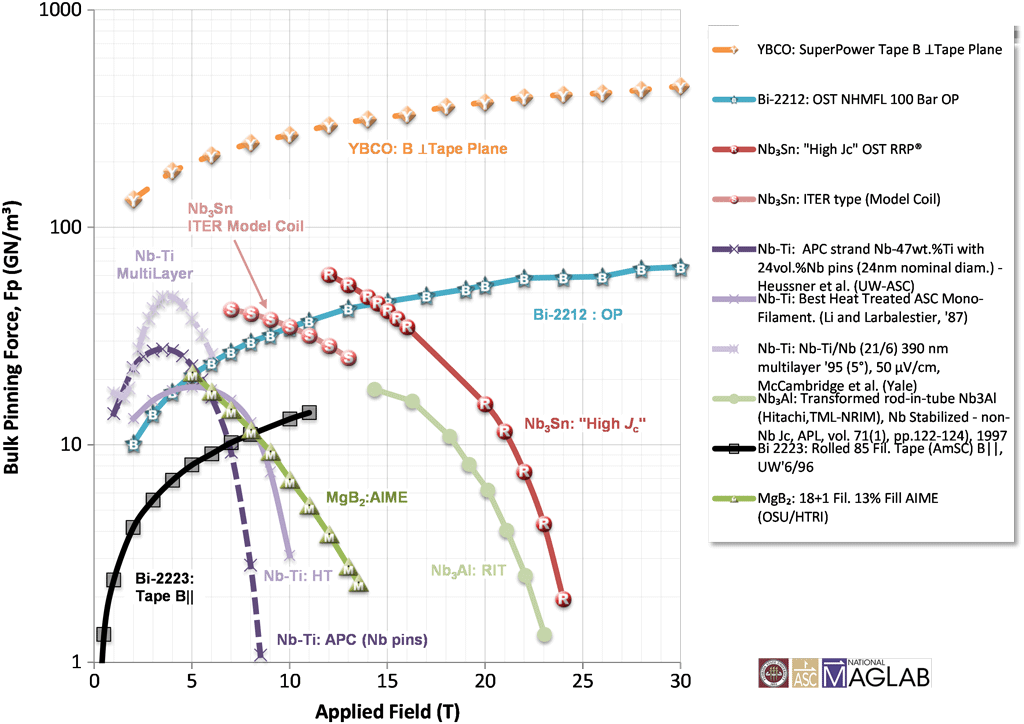
Edited version of comparison between Bulk Pinning Force and Field of a Superconductor

Fp vs B

172 kB PNG
129 kB PNG
Data updated February 24th 2003, Format updated March 30th 2010


Advances in Critical Current Density in Nb-Ti Superconductors at 4.2 K

Fp vs B 59 KB PDF

compiled the data and generated the graphs

Nb3Sn Scaling Spreadsheet - Matthijs Mentink, Diego Arbelaez, Arno Godeke [LBNL]< /br> 


Version 5 Release Notes (January 2010):
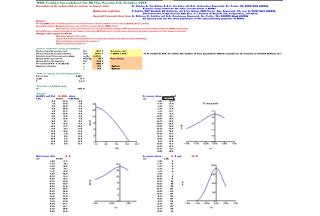
Microsoft Excel spreadsheet that runs a Visual Basic code to allow the user to easily calculate Ic(B,T,strain), Tc(B,strain), and Bc2(T,strain) for Nb3Sn superconductors using a fixed set of material parameters, thereby allowing rapid and convenient parameterizations of measurement results. The calculations are based on scaling relations for Nb3Sn as were published in 2006 and accepted for ITER in 2008. The new spreadsheet includes improvements that were made since then.

The spreadsheet runs on all Microsoft Office versions that include Visual Basic scripting, which is most versions except Office 2008 for MacIntosh OS (Microsoft has unfortunately removed Visual Basic from that package). The user has to tweak the security settings in Excel to enable Visual Basic macro programs to run for the calculations to work. We found "Ask whether macro's to run when opening" a good compromise between the standard high security setting (do not run any macro's) and the lowest security setting that enables all macro's to run in Excel.

The version below is the new public version V5.0. The last public version posted here was V4.2. Changes with respect to V4.2 are:
1. The use of mathematically simplified relations and improved programming
2. The inclusion of a new strain formalism that includes upward curvature in Bc2(strain) for high compressive strains, asymmetry, which is derived from a 3D, three invariant strain description. This improvement stems from requests by Luca Bottura and Bernardo Bordini, who analyzed the available scaling relations for ITER
3. Removal of the axial thermal pre-strain from the material property list. All strain values that are used in the spreadsheet are now intrinsic strain values, i.e. adjusted for the thermal pre-strain
4. The material property list now includes the pinning constants p and q, allowing the user to vary them and/or use them as fit parameters, thereby addressing users desires (e.g. for ITER)
5. The new name (MAG spreadsheet) is derived from the main contributor's last names (Mentink, Arbelaez, Godeke)

Note 1: The Visual Basic code, as in V4.2, uses the full Maki-DeGennes descriptions to calculate Bc2(T) as opposed to it's approximation Bc2(T) ~ Bc2(0)(1-t1.52). We were tempted to simplify the code, but consider simplicity of the mathematics not a good reason to replace an exact, microscopic based description by a less accurate approximation. As pointed out by various users, the approximation only leads to errors of about 0.5 T in Bc2(T), but such errors in Bc2 would lead to undesired significant errors in Ic. Users who would like a version that uses the approximation can edit the source code, which is self-explanatory, or send the authors a request to make a private version.
Note 2: The magnetic fields in the spreadsheet are considered to be total magnetic fields, i.e. self-field corrected values. The user has to apply the appropriate self-field corrections for his/her specific measurement.
Note 3: Feel free to distribute this spreadsheet.
Note 4: Feel free to modify the codes as desired. The authors would like to ask the user to re-name the file appropriately if a modified version is distributed.
Note 5: Tested extensively, but please report bugs using email link below.

Cheers,
Matthijs Mentink, Diego Arbelaez, Arno Godeke [LBNL]

Scaling Spreadsheet - V5 Jan 2010
89 KB Scaling Spreadsheet: Excel Format
26 KB 7z compressed file containing Excel spreadsheet
 

Adobe Acrobat© Reader™ Required to view the papers. Get ACrobat

Daniel's XL Toolbox used to generate some version of the plots.


For more information


Created April 18 2002 ©Peter J. Lee

Last remembered to update date: September 13th 2010


© 1995 - 2011 Peter J. Lee
The Applied Superconductivity Center
Shaw Bldg., 2031 E. Paul Dirac Dr.
Tallahassee FL 32310-3710

Phone:+1 (850) 645-7486
Fax: +1 (850) 645-7754